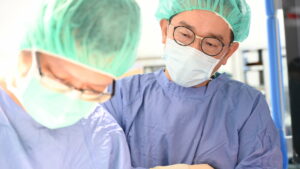
Flexibility is a crucial factor for neurosurgeons, especially during the pre-planning stages of neurosurgery. The decision regarding the entry point for craniotomy can be made based on whether the patient is in a supine or prone position.
Ph.D. MD. Stanley Chuang (Hao-Yu, Chuang) is the Chief of Neuro-Medical Scientific Center of An-Nan National Hospital, whose research interests includes neuro-oncology, neuro-regenerative medicine and medical engineering. He is focusing on brain tumor surgery, cerebrovascular surgery, spine surgery and neuro-functional surgery. According to him, navigation systems often utilize reference markers on the forehead, typically special position markers or imaging markers combined with MRI or CT scans, to determine surgical location and depth. He also shared his clinical experience with NaoTrac, a neurosurgical navigation robot, during the EANS (The European Association of Neurosurgical Societies) 2023 conference in Barcelona, Spain.
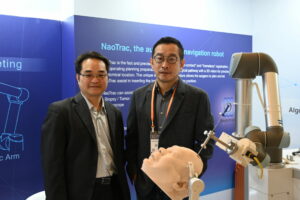
In his interview, Dr. Chuang highlighted the advantages of the prone position during neurosurgery with the utilization of NaoTrac.
The Significant Differences between Supine and Prone Position on Navigation Assisting on Brain Tumor Biopsy Operation
The accuracy and safety of these procedures depend not only on the surgeon’s skill and experience but also on the quality of images, equipment, and tools. Neurosurgeons often divide brain lesions into some anatomic parts of brain. Just like anterior, middle and posterior fossa, also we define the superior and inferior cerebellar tentorial areas.
The choice of surgical method and approach path depends on the lesion’s location, which in turn dictates the patient’s surgical positioning. Lesions near the anterior or middle fossa are generally feasible for surgery in the supine position. However, lesions in the posterior fossa or infra-tentorial area often require the prone position.

The Benefits Performing robotic neurosurgery with NaoTrac for Prone Position, comparing to other Solutions.
Navigation systems play a crucial role in brain surgeries, assisting surgeons in accurately positioning and guiding surgical tools for precise procedures. The application of navigation systems differs between supine and prone surgeries. In supine surgery, navigation systems typically use reference markers on the forehead, usually special positioning markers or imaging markers combined with MRI or CT scans. Conversely, in prone position surgery, navigation systems utilize head reference markers but require different positioning and calibration for accurate navigation.
While traditional brain stereotaxic and navigation systems rely on coordinate positioning and the concept of 3D space, the NaoTrac system utilizes vision-assisted image positioning, similar to the navigation method of Google Street View mapping.
The Outcome Utilizing NaoTrac in Assisting Neurosurgery
At An-Nan Hospital, we have utilized the NaoTrac system in more than 10 patients for prone surgeries. Our experience has shown that the accuracy and precision of the NaoTrac system yield remarkable results, as shared during the EANS 2023 conference. It provides increased flexibility for neurosurgeons during surgery, and I wholeheartedly recommend NaoTrac to my colleagues in the field.”