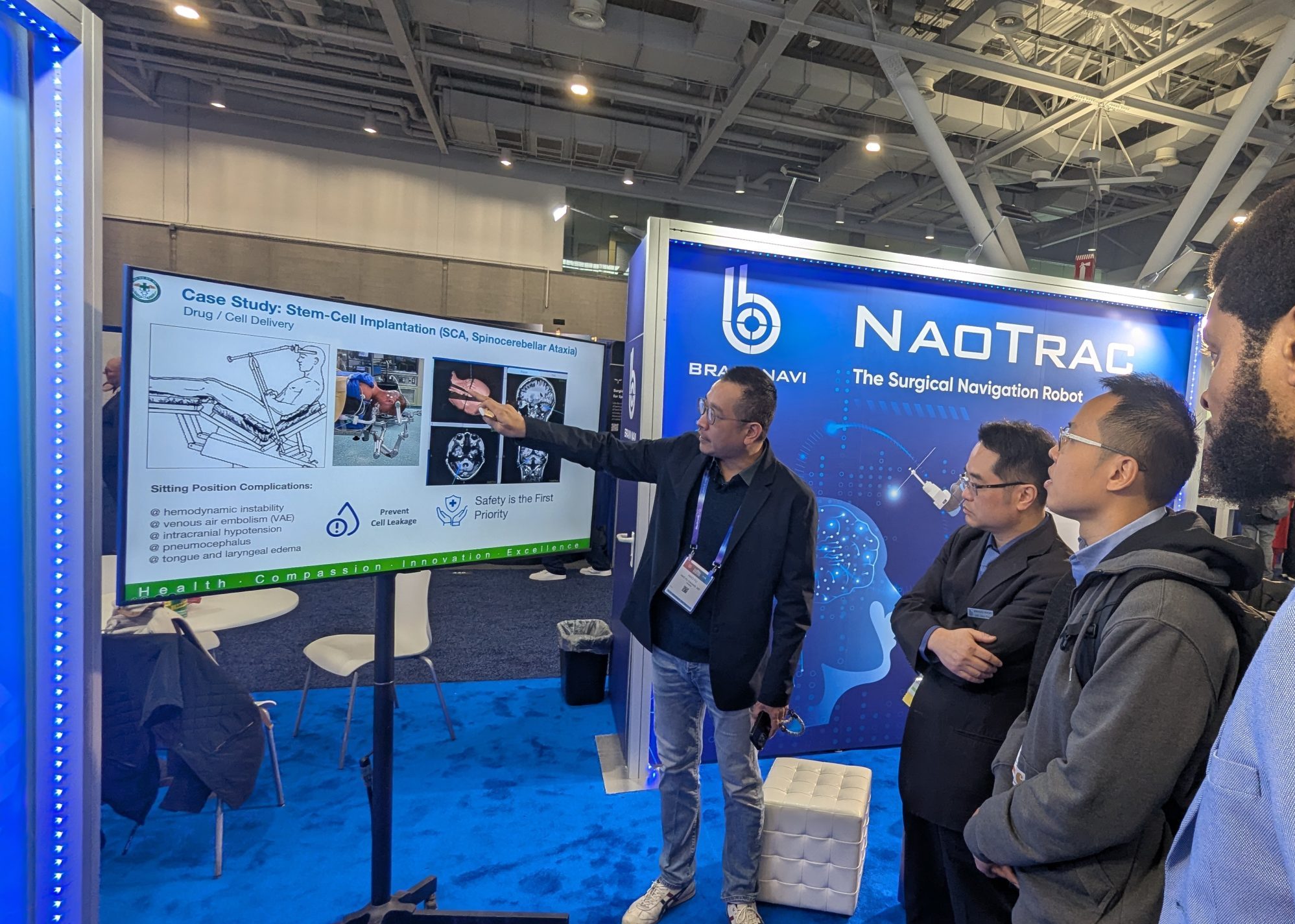
Dr. Stanley Chuang, MD, PhD, is the Vice Superintendent of Neuroscience and Cell-Therapy at An-Nan Hospital, Taiwan. A board-certified neurosurgeon, Dr. Chuang brings extensive expertise in neuro-oncology, skull base surgery, and functional neurosurgery, as well as emerging fields such as neuroregeneration and cell-based therapy. With a strong foundation in both clinical excellence and translational research, Dr. Chuang is dedicated to advancing precision medicine and robotic-assisted solutions in neurosurgical care.
Dr. Chuang has been actively exploring the clinical potential of the NaoTrac robotic surgical navigation system, particularly in complex stereotactic procedures where precision and adaptability are essential. His team has accumulated a growing number of successful cases demonstrating the system’s accuracy and real-world feasibility. This preliminary experience was recognized by the American Association of Neurological Surgeons (AANS), where it was selected for presentation as the presented poster, highlighting the increasing attention toward machine vision-assisted neurosurgical robotics in academic and clinical circles.
Interview with Dr. Hao-Yu Chuang ( Stanley)
Q: Dr. Chuang, could you tell us what led you to adopt NaoTrac in your stereotactic procedures?
A: In stereotactic neurosurgery, precision and speed are critical. What drew me to NaoTrac, the surgical navigation robot, was its use of machine vision for surface registration. Unlike navigation systems that rely on bone markers or facial features, NaoTrac can perform automatic registration based on facial recognition. That makes the setup simpler and faster. After a few successful test cases, we decided to integrate it into our routine workflow.
Q: What kind of procedures have you performed with it so far?
A: From 2023 until now, we’ve performed several robot-assisted stereotactic surgeries with NaoTrac. These included cases of intracranial hemorrhage (ICH) evacuation and brain tumor biopsies. All procedures were conducted in our hybrid operating room, and we used preoperative CT or MRI/CT fusion for planning.
Q: How did the system perform in those cases?
A: Very well. For ICH patients, the catheter was placed successfully on the first attempt in all 9 cases, with an average hematoma clearance of 78.6%. The mean registration time was 54.4 seconds, and surface alignment accuracy was 0.25 mm. The average operation time was average in 64 minutes. For brain tumor cases, 6 patients required a second trajectory, often due to sampling scar tissue. But in all of those, the second attempt yielded a valid pathology result. Registration accuracy averaged 0.29 mm, and the operation time was around 80 minutes.
Q: Let’s talk about the prone cases specifically. How did NaoTrac adapt?
We performed 7 brain tumor biopsy cases in the prone position, which presents unique challenges for registration, as conventional surface mapping techniques often rely on facial landmarks that are not accessible in this orientation. To address this, we applied skin fiducial markers to the occipital region, enabling NaoTrac’s machine vision system to perform accurate surface-based registration. The results demonstrated both high reliability and precision under these non-standard positioning conditions.
Q: Were there any differences in the outcomes or workflow?
A: Actually, the prone cases performed even better in some respects. The average registration time was 56.14 seconds, and the alignment accuracy improved slightly to 0.20 mm. Operation time was 88 minutes on average, which is acceptable given the complexity. What’s most important is that the system’s flexibility allows us to work in any patient position without compromising precision.
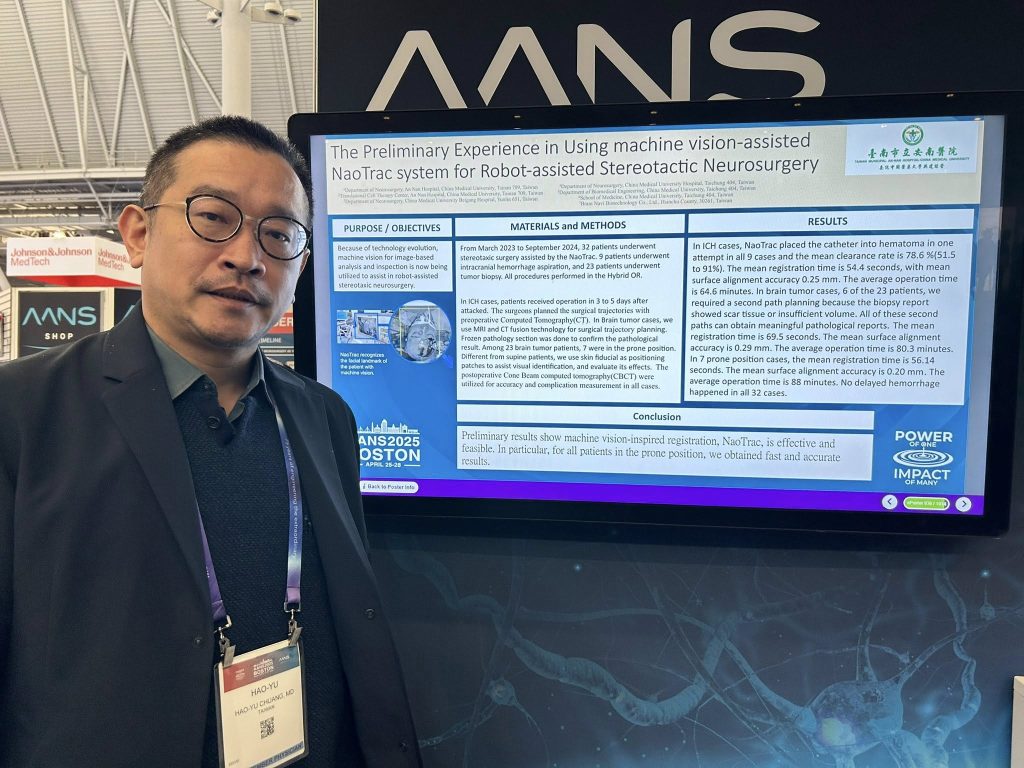
As Dr. Chuang concluded, the preliminary findings demonstrate that NaoTrac’s machine vision-based registration system offers both operational efficiency and submillimetric accuracy, across varying patient positions including supine and prone configurations. The system’s ability to adapt to diverse anatomical orientations without compromising precision underscores its clinical robustness.
Moving forward, there is considerable potential for NaoTrac to be further integrated into a broader range of functional and stereotactic neurosurgical procedures, where reliable, image-guided navigation is essential to ensuring procedural safety and efficacy. Continued clinical validation and interdisciplinary collaboration will be key to realizing its full potential in the evolving landscape of neurosurgical robotics.